Posts

Archbishop Ieronymos of Athens: "For each of us to receive the vaccine is an act of Christian solidarity and love for our neighbor"

Image
Our Church, both clergy and laity, hopes and prays that we will be able to celebrate the days of the Holy Passion and the Resurrection of our Lord within and alongside our Churches by observing all of the appropriate health rules and the necessary measures for the protection of the supreme good of the health and the life of our fellow human beings. It is our duty, however, to take on the responsibilities that belong to each and every one of us as responsible citizens and faithful Christians. I will say it again with all the strength of my heart: for each of us to receive the vaccine, especially those of us who are elderly, is not only an act of individual responsibility, but also an act of Christian solidarity and love for our neighbor. As Christians, we are a people who are absolutely free to make our own choices. And God desires for us to make use of our insight and understanding to always choose that which is good. When we receive the vaccine, making the best use of this gift of God...
The Unity of the Spirit in the Bond of Peace

Image
One of the most common complaints that people have about Christians throughout the world is the disunity and division that are so common among Churches today. The numbers here are truly staggering. Our Lord Jesus Christ founded one Church as his one Body, united by the one Holy Spirit. Despite this unity that is at the center of our faith, divisions among Christians only continue to increase. Today, there are over 35,000 denominations within the Protestant world. This number continues to grow every year as divisions increase and groups splinter off from one another. You can see in this trend a clear failure to live up to the appeal that St. Paul gave to the people of Corinth when he saw division there: "That there be no divisions among you, but that you be united in the same mind and the same judgment," (1 Cor. 1:10). As Orthodox Christians, can we provide a better example of the "unity of the Spirit in the bond of peace" (Eph. 4:3) that is our calling in Christ? ...

What Kind of Life Are You Building?

Image
Whenever a building is put together, there are certain things that need to be in place before construction can begin. If a building is constructed at random, then it will not stand to test of time, but will fall apart as soon as the first storm hits. The construction team has to know what kind of building they are going to produce. Homes are constructed very differently from stores, and skyscrapers need special considerations. Then, an architect needs to draw up a blueprint that tells the construction team what the final product should look like. Buildings are always constructed with a purpose and a plan. Our lives are very similar to the construction of a building. When we focus all of our effort on earthly things like wealth, possessions, or reputation, we build our lives into one type of building. This is what the man in today's Gospel is doing when he decides to build large storehouses for all his material goods. All the earthly goods that we acquire are temporary. When we pass...

Bringing Hope to the Hopeless

Image
What do we do when we find ourselves losing hope? Our lives today give us plenty of opportunities to fall into despair and hopelessness. How do we keep our hope when our circumstances seem so difficult? How can we be a people of hope, making our own what St. Paul calls our "steadfastness of hope in our Lord Jesus Christ," (1 Thess. 1:3)? Today's Gospel reading gives us a lesson on hopeless situations. We see a woman who has been ill for twelve years, and who has become poor and socially outcast because of her illness. We see also a man whose 12-year-old daughter, his only child, lies on her deathbed. Both of them have lost hope, and they come to Jesus in their hopelessness. In both of these situations, Jesus brings an unexpected result. When the woman who had been ill for so long touches Jesus’ garment, he makes the new creation known to her. “Daughter, your faith has made you well,” (Luke 8:48). When she touched him, according to Old Testament purity laws, he should hi...

Love and Charity

Image
Think of all the different ways we use the word 'love'. 'Love' describes a whole spectrum of different relationships. I love my friends, and I love my child, and I love my parents, and I love my wife. These are four very different relationships, but we use the word 'love' to describe all of them. We even talk about love outside of human relationships. Some people love golf, others love hamburgers, still others love democracy, and some people love Hawaii. How can one word, 'love,' be used for all these different things? In Greek, there are at least four kinds of love. Φιλία ( filia ) is the love that a person has for their friends. This is the kind of love that makes people feel like they're part of a team. Στοργή ( storgi ) is a kind of doting, affectionate love. This is the kind of love that a mother often has for her child. Έρος ( eros ) is erotic, sexual love. This kind of love is an expression of our desire for another person. But the highest, th...

Sitting at the Feet of Jesus

Image
Modern life leaves us very little room for quiet. Our lives today are increasingly busy, and we have little time for seeking peace and stillness. Modern technology brings the noisiness of our social lives into our homes, removing even the illusion of privacy and seclusion. Since the beginning of the pandemic, many of us find that even are work lives are encroaching more and more on our personal time. It is well-known that the hectic pace of our lives today tends to cause a host of psychological issues. But it causes us spiritual issues as well. As long as our lives are filled with busy-ness, then we have left no room for Jesus Christ. As long as our schedules are packed full, then we have left no time for Jesus Christ. Many of us today are starved spiritually because there is no place in our lives for quiet alone-ness with God. A pitcher that is empty cannot fill the cups of others. A power strip cannot give electricity to your devices unless it is plugged in to the source of that elec...

The Little Prayer

Image
We often speak about growing in prayer, about developing our lives of prayer. But what does it mean to grow in prayer? How do we do it? This is, of course, an inexhaustible question. Every person's life of prayer is different, just as every person is different. Everyone grows in prayer differently, even though there are certain 'landmarks' along the way that are similar for everyone. The following is a little hymn about prayer. Some sources attribute it to St. Paisios of the Holy Mountain. The theme of this hymn is the Jesus Prayer, and how it descends from your mind into your heart when you pray it with humility and stillness. I have offered here my feeble attempts at a translation of this hymn, which I have not found elsewhere in English.     Η Ευχούλα - The Little Prayer Eίναι η έρημος πικρά μα θα γίνει και γλυκιά όταν λεω τη ευχη με ταπείνωση πολύ It is a bitter desert, but will become also sweet When I say the prayer with great humility. Θεέ μου δως μου αντοχή για να ...

It Is the Day of Resurrection!: Holy Pascha and the empty tomb

Image
Christ went down alone to battle Hades, He came up taking with Him many spoils of victory. -Synaxarion of Holy Pascha Anastasis Icon, Chora Church, Constantinople Sometimes it is when life seems at its lowest, when the pain of the present circumstances seems most unbearable, when hope seems most fully to have died out, that life springs unexpectedly from the grave. Sometimes we find that it is only by staying present within life's uncertainties that we are able to push through to the joy that waits on the other side of suffering. That was surely the experience that the Apostles had while Jesus lay in the grave. Even more than that, imagine the suffering that Mary endured watching Jesus being taken down from the Cross and laid in a tomb. Mary's suffering was perhaps twice what the Apostles experienced; her son and her God died on the Cross on Holy Friday. Icons of the lamentation over Christ's body show his mother as a woman completely undone by her sorrow. ...

Your Cross is Life and Resurrection: Holy Friday and the Crucifixion of Christ

Image
Even dead on the Cross, You as God are living, O naked corpse and living God's Logos. -Synaxarion of Holy Friday Orthros Icon of the Crucifixion   Holy Friday is the day on which the creator of all things willingly accepted death for the salvation of his creation. It is on this day that the Word of God "for whom and by whom all things exist" (Hebrews 2:10) offered his own life to us in the ultimate act of self-empyting. The Synaxarion reading for the Orthros service of Holy Friday tells us the gravity of this day: "On this day, Holy and Great Friday, we celebrate the awesome, holy, and saving Passion of our Lord and God and Savior Jesus Christ: the spitting, the blows, the buffeting, the mockery, the reviling, the purple robe, the reed, the sponge, the vinegar, the nails, the spear, and above all, the Cross and Death which He condescended to endure willingly for our sakes." The Orthros service, often referred to as the 'Twelve Passion...

The New Pascha: Holy Thursday and the Mystical Supper

Image
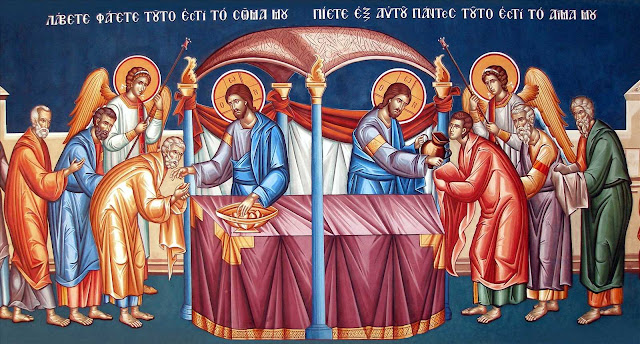
Double Supper: it has the Law's Pascha, The new Pascha also, the Lord's Blood and Body. -Synaxarion for Holy Thursday Mystical Supper Icon Holy Thursday is crucial to understanding the narrative of Holy Week. Holy Thursday tells us the story of the events that directly preceded the Passion. But it is not simply a prologue to Holy Friday; the events of Holy Thursday are of such great spiritual significance that the whole sacramental practice of the Church cannot be understood without understanding Holy Thursday. The Synaxarion that is read at the Orthros service on the evening of Holy Wednesday tells us that Holy Thursday is dedicated primarily to four events: Jesus washing the disciples' feet before the Mystical Supper The Mystical Supper itself Jesus' prayer in the Garden of Gethsemane The betrayal of Jesus by Judas The Gospel reading that is read at the Vesperal Presanctified Liturgy on Holy Thursday morning shows us all four of these events,...

Accept Me Now as I am Repenting: Holy Wednesday and the anointing of Jesus

Image
"The harlot let out her hair for You the Master; Judas put out his hand to the transgressors of the Law." -Aposticha of Bridegroom Orthros for Holy Wednesday The harlot anoints Jesus for his burial Yesterday we saw Jesus speaking with his disciples about his second coming, and giving images to help the disciples understand what his second coming will be like. All of the Gospel readings for Holy Week that we have seen so far have focused on Jesus' the things Jesus taught while in Jerusalem. Holy Wednesday marks a transition in the narrative of Holy Week from Jesus' teaching ministry to the events directly leading up to his passion. The focus of the hymnology and the Gospel reading ( Matthew 26:6-16 ) for Holy Wednesday is Jesus' anointing with an expensive ointment by a woman who is identified by Luke 7:36-50 simply as a 'sinful woman.' Moreover, she is someone who is known publicly as living a sinful life. This supports her identification ...